Why Holistic Education For Child Development Is Important? Explain.
Apr 04, 2026
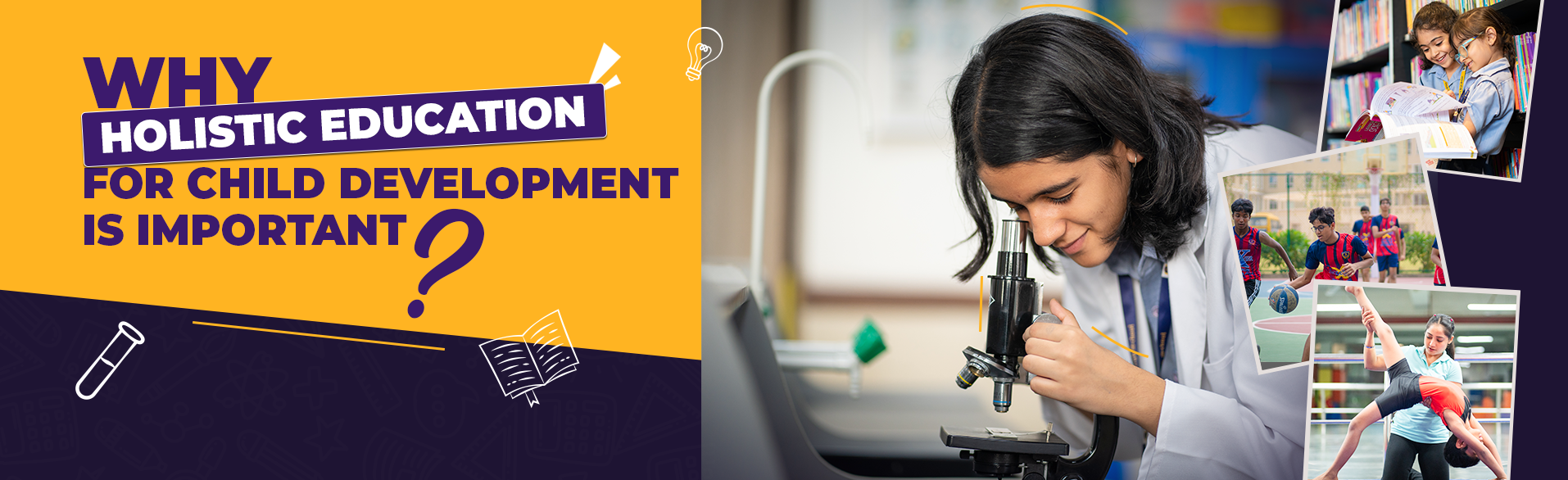
Holistic Education for Child Development
Holistic education for child development is one of those phrases that gets spread around a lot in school brochures and parent meetings but usually without anyone explaining what it actually means for a child sitting in a real classroom.
The difference between a school that genuinely practices it and one that just shows it on their website is something parents feel within the first few weeks, even if they cannot name it immediately.
The Importance of Holistic Education Goes Beyond Report Cards
The importance of holistic education shows up most clearly in what it does not measure. An example of this is a child who is excellent in all tests but fails to work on the project which involves teamwork thus the gap cannot be given a grade. An emotionally stable child who is inquisitive and able to overcome challenges is full of something much more enduring than a grade point average.
The idea of holistic education is based on the fact that a child is not only a student. They are a growing human being, whose intellectual, physical, emotional, social and creative aspects must be taken care of, not just academics.
Schools which understand that make curricula that develop all of those dimensions at the same time. The classroom is the kind of place where a child gets a lesson on mathematics, as well as the lesson about dealing with a mistake. Both lessons stay with them.
What Holistic Development in Education Actually Looks Like
Holistic development in education isn't a special programme that only runs on Friday afternoons. In fact, it is infused throughout the school day. It begins with the reaction of teachers when a child becomes frustrated during a lesson, and goes further to whether the school offers time and space to be involved in unstructured creative play.
A school that is actually dedicated to whole-child development demonstrates this within a short period of time. The teachers address children as human beings and not things. Mistakes are regarded as learning opportunities and not as failures. Age-appropriate options are offered to children and they are allowed to have natural consequences. Maths and English are not considered more important than the arts, physical education, or even social activities.
These choices matter. They shape a child’s relationship with the learning process, years after they are out of that school.
Holistic Learning Approach in Schools: What Sets It Apart
A holistic learning approach in schools looks different from traditional instruction-based schooling in a few ways that parents notice almost immediately.
Children are encouraged to ask questions rather than just answer them. Learning moves across subjects rather than staying locked in separate boxes. A history lesson might connect to geography, which connects to a discussion about how people make decisions under pressure, which connects to something the class is reading. That kind of cross-subject thinking is not accidental. It is the result of teachers who plan with the whole child in mind.
Project-based learning, collaborative problem-solving, and experiential activities are all expressions of this approach. Child overall development in school depends on children having enough varied experience to understand their own strengths, not just their exam performance.
One classroom observation captures this simply in a holistically designed classroom, a child who is struggling academically is still thriving somewhere. The school has built enough pathways to growth that no single child has to define themselves by the one area where they find things hard.
Cognitive Development in Education: More Than Memory
Most parents associate school with cognitive development in education, and rightly so. But cognitive development is not the same as memorisation. Genuine intellectual growth involves reasoning, pattern recognition, creative problem-solving, and the ability to apply knowledge in situations that are different from the one it was first learned in.
A child who has been taught to think, rather than simply to recall, performs better under pressure, adapts to unfamiliar challenges more easily, and retains information longer because it is connected to understanding rather than repetition.
Holistic schools build this by designing tasks that require children to use what they know in new ways. A science concept demonstrated through a hands-on experiment, then discussed as a group, and then written about independently, produces deeper learning than the same concept explained once and tested the following week.
Emotional and Social Development in Children
Emotional and social development in children does not happen automatically with age. It happens through experience, and the quality of that experience inside school makes an enormous difference.
A child who spends years in an environment where only performance is valued learns to associate their worth with their output. When things go wrong academically, as they inevitably will for every child at some point, that child has no other measure of themselves to fall back on.
Schools that explicitly develop emotional literacy give children a richer internal resource. They learn to name what they are feeling, to understand why, and to work through it without it derailing everything else. This is not soft content. It is arguably the most practical skill a school can build, because it applies to every other area of life.
Social skills follow the same logic. The ability to collaborate, to listen properly, to navigate disagreement without falling apart, and to contribute to something larger than yourself are developed through deliberate social experience. Group projects, team activities, and community involvement inside school are all doing this work.
Modern Teaching Methods for Child Development
Modern teaching methods for child development that support a holistic approach go well beyond the traditional lecture and textbook model.
Inquiry-based learning asks children to investigate before they are given answers. Experiential learning places them in situations where they have to figure things out by doing. Differentiated instruction acknowledges that twenty-five children in a room do not all learn at the same pace or in the same way and builds accordingly.
Technology, used thoughtfully rather than reflexively, opens up access to global perspectives and collaborative tools that were not available to previous generations of students. The key word is thoughtfully. Screens for their own sake add nothing. Screens as a vehicle for genuine exploration and creation are a completely different proposition.
Skills Developed Through Holistic Education
The skills developed through holistic education are the ones that compound over a lifetime. They are not specific to any single career path or subject area, which is precisely what makes them so valuable.
- Confidence in approaching problems they have not encountered before
- The ability to work effectively with people who think differently from them
- Resilience when things do not go to plan the first time
- Creative thinking that is not limited to the subjects labelled as creative
- Self-awareness about how they learn, what they find difficult, and how to ask for help
- Communication skills that hold up in both written and spoken contexts
These are not incidental outcomes. They are what good education is supposed to produce, and a holistic framework is the most reliable way to produce them systematically.
Student Growth and Development in Schools: The Long View
Student growth and development in schools is most meaningful when it is tracked across multiple dimensions, not just academic progress. A school genuinely invested in its students notices when a quiet child is finding their voice. It notices when a confident performer is quietly struggling. It creates the conditions where both matter.
The benefits of holistic learning for children are not visible only at graduation. They show up in how a teenager handles pressure. In how a young adult approaches a new environment. In how a person relates to people who are different from them.
The foundations for all of that are laid in school, year by year, through the accumulation of small experiences that either build a whole person or do not.
A School That Sees the Whole Child
Holistic education for child development is not a teaching trend. It is a commitment to what school is fundamentally for. Not to produce high scorers, though those are a welcome outcome. To produce people who are genuinely equipped for the life they are actually going to live.
At St. Xavier's High School Gurgaon, that commitment shapes how we teach, how we assess progress, and how we think about every child who walks into our classrooms. Because the goal has never been to fill seats with students. It has always been to send whole, capable, confident people back out into the world.